Constant Contact:
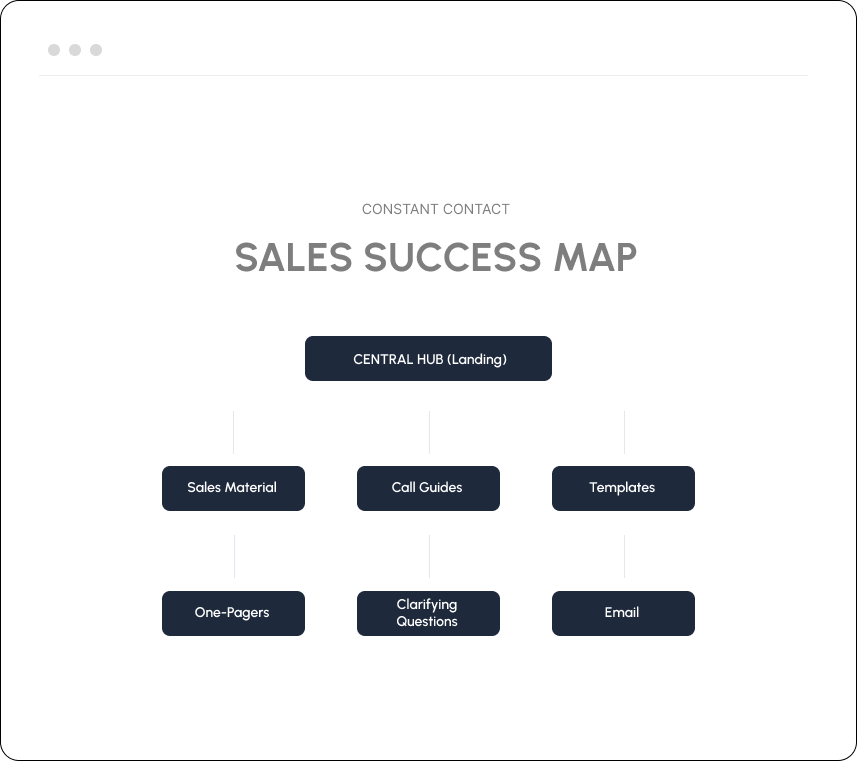
The Sales Success Map
How a light design task became a self-directed information architecture overhaul that changed how a global sales team works.
Quick Summary
The Problem: What started as a light PowerPoint polish job slowly became a 100+ page printed binder that sales reps had to manually update page by page. There was no way to navigate it quickly during a live call, no version control, and no way for the broader team to maintain it without reprinting.
The Fix: Through self-directed research and incremental prototyping — first an interactive InDesign PDF, then a branching Google Sites repository — I grew the scope of the project from a design task into a full information architecture overhaul, spearheaded as a junior designer on the channel enablement team.
The Result: The Sales Success Map became a one-stop internal repository for all sales material across a 500+ person global workforce, formally recognized by the Chief Sales Officer for its impact on sales velocity and onboarding accuracy. The system is likely still in use today.
Role: Senior Systems Designer
Tools: Adobe InDesign, Google Sites, Figma (system documentation)
Scale: 500+ Users / Global Workforce
Focus: Information Architecture & Design Ops
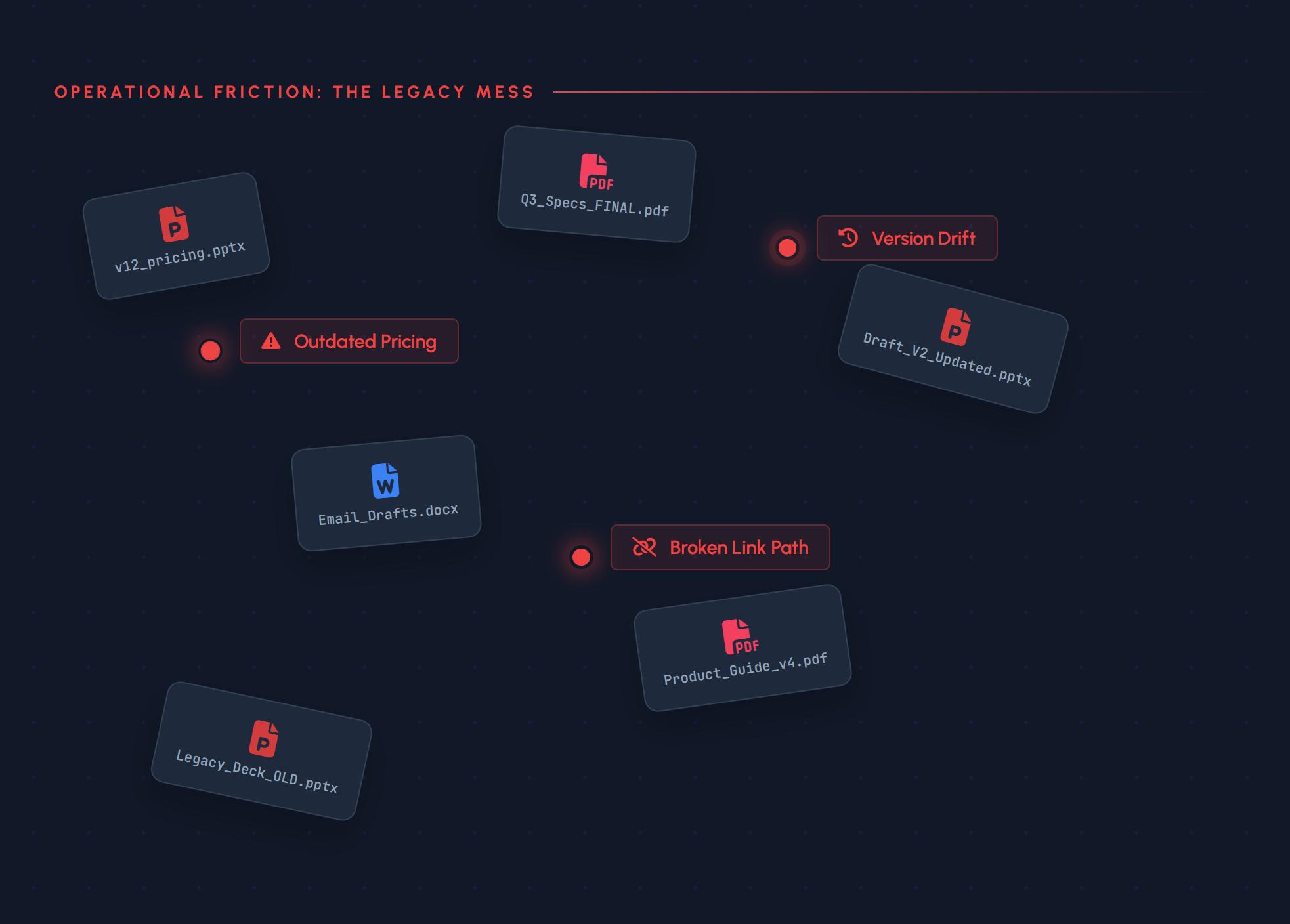
Mapping the Legacy Friction: Scattered files and static 100-page decks that created significant cognitive bottlenecks and version drift for the global sales team.
The Challenge
A Design Task That Kept Growing
I was brought in to do a light visual lift — clean up a PowerPoint template, add title pages, tighten the typography. The content was owned by the channel enablement team and the tool was intended to become a printed binder that sales reps could tab through during live calls.
But the document kept growing. By the time it crossed 100 pages, the cracks were obvious. Reps were printing new pages and manually inserting them into physical binders every time content changed. During a live sales call, flipping through a hundred printed pages to find the right objection handler wasn't just slow — it was embarrassing for the rep and damaging to the sale.
Nobody had formally identified this as a design problem. But my manager mentioned that many reps on the sales floor had quietly abandoned the binder entirely and were taking calls without any script or reference material — bad for consistency, bad for conversion, bad for new hire ramp time. The tool meant to support them had become more friction than it was worth. That context is what pushed me to find a better solution, even though nobody had asked me to.
The EVOLUTION
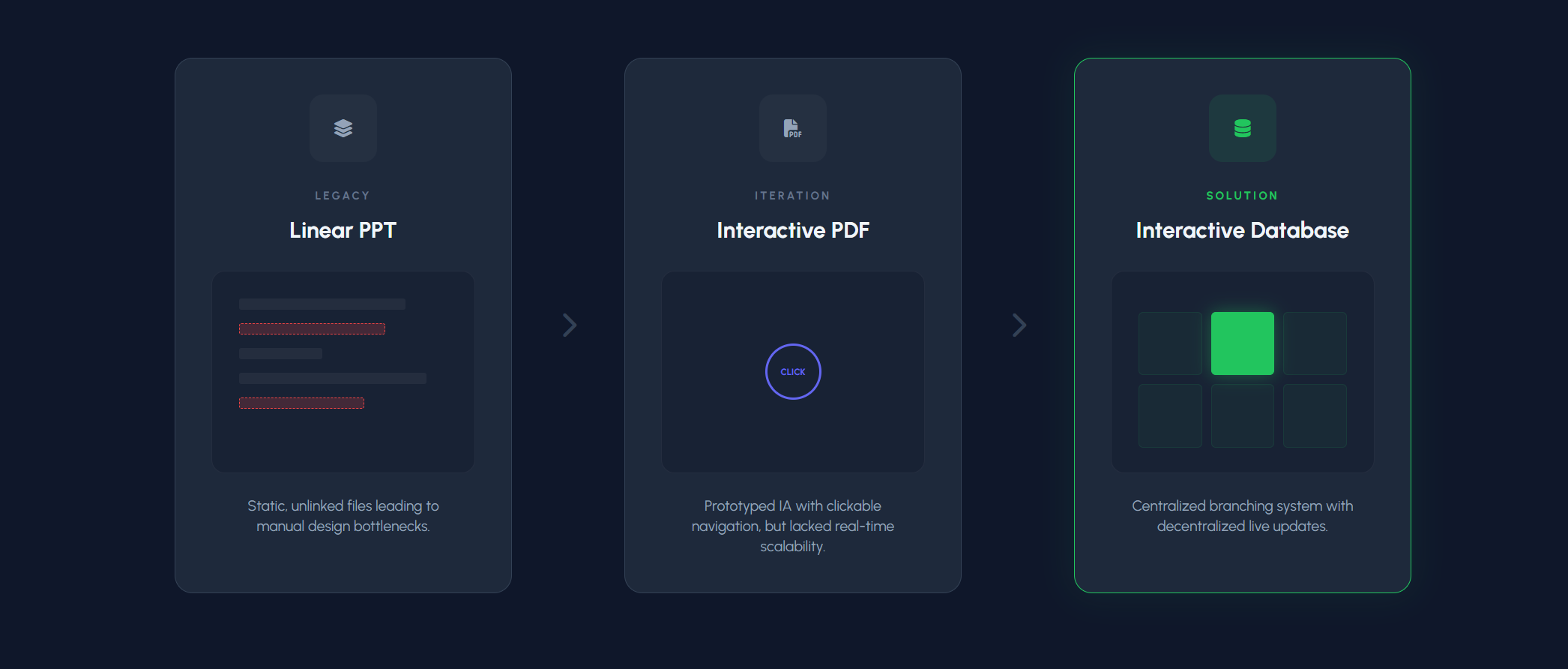
The Architectural Pivot: Moving from a linear PowerPoint sequence to a modular, branching Information Architecture
From Linear to Branching
I led a multi-stage migration to modernize the workflow and reduce the "Version Drift":
Phase 1: The Printed Binder: The original format was a PowerPoint designed to be printed, tabbed, and referenced during live calls. As the document grew past 100 pages, maintenance became unsustainable — every content update meant reprinting and manually reinserting pages. Reps stopped using it.
Phase 2: The InDesign Prototype: While working in Adobe InDesign on other projects, I discovered it could export interactive PDFs with buttons and internal navigation. I researched the feature independently, built a shortened prototype of the SSM with clickable navigation, and presented it to my manager without being asked to. It worked — navigation was dramatically faster and the format felt closer to how reps actually needed to move through content during a call.
But the same constraint surfaced that I'd later encounter at Wayfair: the tool required specialized software. The rest of the channel enablement team couldn't edit InDesign files, which meant all content updates still bottlenecked through me. Scalable design, but not a scalable system.
Phase 3: Google Sites: My manager asked me to look into other hosting options. I researched quickly and landed on Google Sites — already part of our Google Workspace, familiar to some teams, and editable by anyone with access. I built a quick proof-of-concept landing page and presented it within days. It was an immediate yes.
The shift to a web-based format opened up something we hadn't anticipated: for the first time, the SSM could behave like a website rather than a document. I sketched out a branching information architecture — a home page with navigation paths organized by sales scenario rather than a linear sequence of slides. That sketch became the structural foundation for what the SSM eventually grew into: a one-stop internal repository for all sales material across the organization.
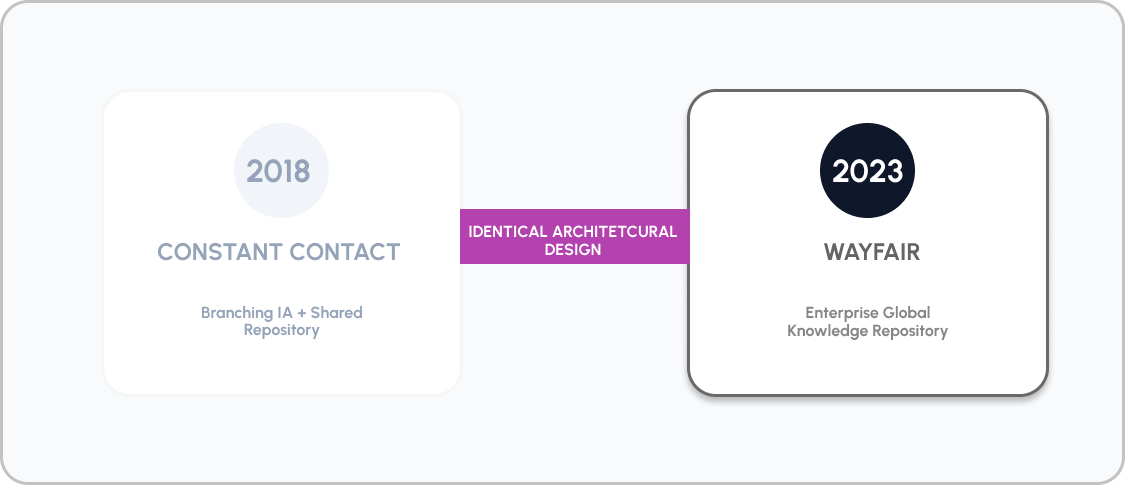
Proving Scalability: A direct comparison of the architectural logic used in the Sales Success Map (2018) vs. the enterprise-level global knowledge systems utilized by Wayfair (2023).
The result
What began as a PowerPoint cleanup became the foundational sales infrastructure for a 500+ person global workforce. The Sales Success Map evolved from a printed binder into a branching internal repository — a single source of truth for objection handlers, email templates, product guides, and onboarding material across the entire sales organization.
The Chief Sales Officer formally recognized the work for its measurable impact on sales velocity and onboarding accuracy. That recognition came not because the design was polished, but because it solved a real operational problem that had been quietly undermining the sales floor.
The repository is likely still in use today — years after the project formally ended. That longevity is the metric I'm most proud of. A system that survives leadership changes, team turnover, and product evolution was built right.
A note on architectural pattern: When I joined Wayfair years later, their global internal knowledge repositories used the same branching information architecture I had developed at Constant Contact. I didn't know that going in. Finding it there confirmed that what felt like a scrappy internal solution was actually an enterprise-grade pattern — one that scales.
Infrastructure That Outlasted the Project
"The Sales Success Map (SSM) moved us from a fragmented library of files to a single source of truth that empowered our global team to sell with precision."
Next Project